
Table of Contents
Question 1
Find the Fourier transform of the following signal. Hint: make good use of the  function.
\begin{figure}[h]
\centering
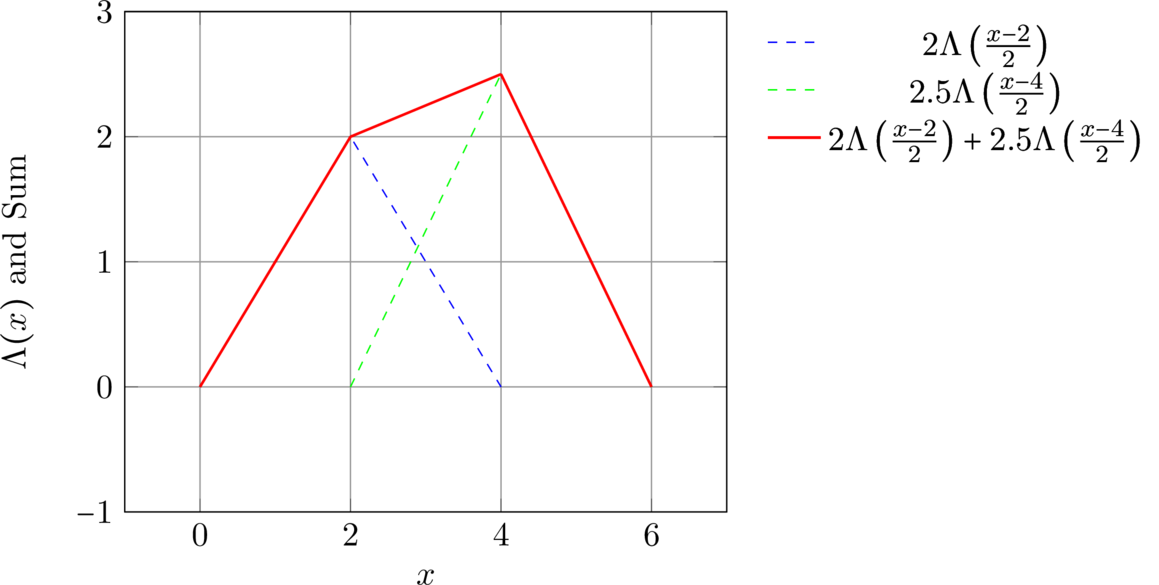
\caption{Time-domain representation of the signal in Question 1.}
\end{figure}
Answer:
We first derive the Fourier transform of the scaled triangular function  . Using the Fourier transform convention
![\[\mathcal{F}\{f(x)\}(s)=\int_{-\infty}^{\infty} f(x)e^{-i2\pi sx}\,dx,\]](images/quicklatex.com-7469763b97eee912bf6ab82ca47ceb62_l3.png)
and the normalized definition  , we have
![\[\begin{align} \mathcal{F}\left\{\Lambda\left(\frac{x}{c}\right)\right\} &= \int_{-c}^{c} \Lambda\left(\frac{x}{c}\right)e^{-i2\pi sx}\,dx. \end{align}\]](images/quicklatex.com-7a4316fbb2df231960c74279ff9ef09f_l3.png)
Let , so 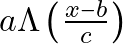 and
and  . Then
![\[\begin{align} \mathcal{F}\left\{\Lambda\left(\frac{x}{c}\right)\right\} &= c\int_{-1}^{1}\Lambda(y)e^{-i2\pi(sc)y}\,dy \\ &= c\,\mathbf{sinc}^2(cs). \end{align}\]](images/quicklatex.com-7a4316fbb2df231960c74279ff9ef09f_l3.png)
Using the shift property of the Fourier transform,
![\[ g(t-b) \xleftrightarrow{\mathcal{F}} e^{-j2\pi bs}G(s), \]](images/quicklatex.com-7469763b97eee912bf6ab82ca47ceb62_l3.png)
we obtain the generalized form for :
![\[ \mathcal{F}\left\{a\Lambda\left(\frac{x-b}{c}\right)\right\}=ac\,e^{-j2\pi bs}\mathbf{sinc}^2(cs). \]](images/quicklatex.com-6e1e6949b6462642244daa56b6f6e559_l3.png)
Applying this formula to the signal in Question 1 gives
![\[\begin{align} \mathcal{F}\left\{2\Lambda\left(\frac{x-2}{2}\right)+2.5\Lambda\left(\frac{x-4}{2}\right)\right\} &= 4e^{-j4\pi s}\mathbf{sinc}^2(2s)+5e^{-j8\pi s}\mathbf{sinc}^2(2s) \\ &= \left(4e^{-j4\pi s}+5e^{-j8\pi s}\right)\mathbf{sinc}^2(2s). \end{align}\]](images/quicklatex.com-9720ee1e0d96e06cedf2164f5dc432fa_l3.png)
Therefore, the Fourier transform of the given signal is
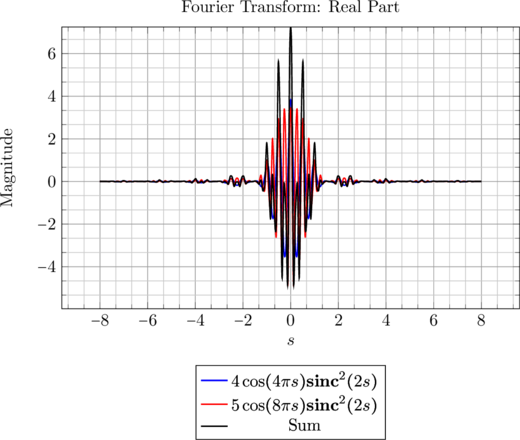
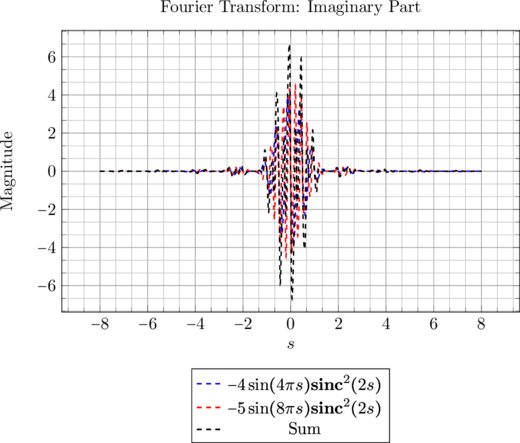
![\[\boxed{X(s)=\left(4e^{-j4\pi s}+5e^{-j8\pi s}\right)\mathbf{sinc}^2(2s)}.\]](images/quicklatex.com-9720ee1e0d96e06cedf2164f5dc432fa_l3.png)
\begin{figure}[h]
\centering
\hbox{
\hspace{1cm}
}
\caption{Fourier transform of : real and imaginary parts.}
\label{fig:fourier_transform_2D}
\end{figure}