
Table of Contents
The Mystery Posed
Question 3
Let $f(t)$ be a real signal with Fourier transform $F(s)$. We are given three clues:
- $f(t)$ is real.
- $f(t) = 0$ for $t \leq 0$.
- $\mathcal{F}^{-1}\{\operatorname{Re}\{F(s)\}\} = |t|e^{-|t|}$.
Goal: find $f(t)$.
The Mathematical Prologue: Odd and Even Functions
Every real function $f(t)$ can be decomposed into its even and odd parts:
![\[ f(t) = f_{\text{even}}(t) + f_{\text{odd}}(t) \]](images/quicklatex.com-56aa14559b275643632fba881313266e_l3.png)
where
![\[ f_{\text{even}}(t) = \frac{f(t) + f(-t)}{2} \]](images/quicklatex.com-2f70346e68e13fb469c0e344a93b63c9_l3.png)
and
![\[ f_{\text{odd}}(t) = \frac{f(t) – f(-t)}{2} \]](images/quicklatex.com-57534cff7159414fefe67c519516eeff_l3.png)
This decomposition is the key to decoding $f(t)$.
Charting the Unknown
The Initial Pathway
Because $f(t)$ is real, its even component contributes to the real part of its Fourier transform, while its odd component contributes to the imaginary part. Therefore, if we know the inverse Fourier transform of $\operatorname{Re}\{F(s)\}$, we know the even part of $f(t)$.
The Schematic Blueprint
Our reasoning can be summarized as follows:
![\[ \begin{array}{cccccccccccc} & & f(t)& \\ & & \updownarrow{\text{Decompose}}& \\ & f_{\text{odd}}(t) & + & f_{\text{even}}(t) \\ & \downarrow \mathcal{F} & & \downarrow \mathcal{F} \\ & F_{\text{odd}}(s) \, (\text{Imaginary, Odd}) & + & F_{\text{even}}(s) \, (\text{Real, Even}) \\ & \downarrow \text{Re\{\}} & & \downarrow \text{Re\{\}} \\ & 0 & + & \text{Re}\{ F_{\text{even}}(s) \} \\ & \downarrow \mathcal{F}^{-1} & & \downarrow \mathcal{F}^{-1} \\ & 0 & + & \mathcal{F}^{-1}\{\text{Re}\{ F_{\text{even}}(s) \}\} \\ & & \downarrow & \\ & & \mathcal{F}^{-1}\{\text{Re}\{ F(s) \}\} = |t| e^{-|t|} & \end{array} \]](images/quicklatex.com-16c394d1bd9a4fb0a268377cb274e6f4_l3.png)
The Crucial Insight
Since
![\[ \begin{array}{ccc} f_{\text{odd}}(t) + f_{\text{even}}(t) & = & 0 \, (\text{for } t < 0) \end{array} \]](images/quicklatex.com-6e74187270ce579d048387e868cc0988_l3.png)
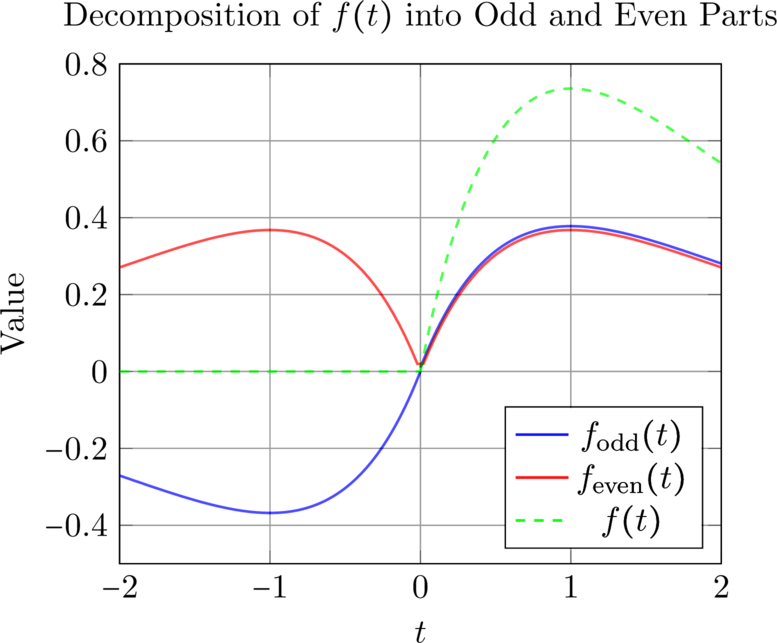
and the even part is $f_{\text{even}}(t)=|t|e^{-|t|}$, we have
$f_{\text{odd}}(t) = -f_{\text{even}}(t) = -|t|e^{-|t|}$ for $t < 0$.
The Final Revelation
Because $f_{\text{odd}}$ is odd,
![\[ \begin{array}{ccc} f_{\text{odd}}(t) & = & \begin{cases} -|t| e^{-|t|} & \text{for } t < 0 \\ t e^{-t} & \text{for } t > 0 \end{cases} \end{array} \]](images/quicklatex.com-6996bbbf788fe4c2c8ba6f100cc8e8cf_l3.png)
The original function is therefore
![\[ \begin{array}{ccc} f(t) & = & \begin{cases} 0 & \text{for } t \leq 0 \\ 2 t e^{-t} & \text{for } t > 0 \end{cases} \end{array} \]](images/quicklatex.com-6626e06a91e5544724ca195b59140c26_l3.png)
Epilogue: The Signal Decoded
The signal $f(t)$ is no longer an enigma. What began as a Fourier transform puzzle becomes a direct application of even-odd decomposition: the inverse transform of the real part gives the even component, and the one-sided condition determines the odd component. Thus,
The Saga Continues: Unlocking Further Mysteries of Fourier Transforms
Question 4
Consider two functions $f(t)$ and $g(t)$, illustrated in the figures below. Their Fourier transforms are denoted by $F(s)$ and $G(s)$, respectively.
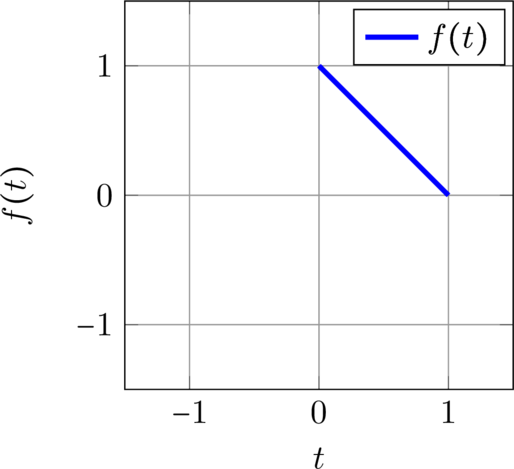
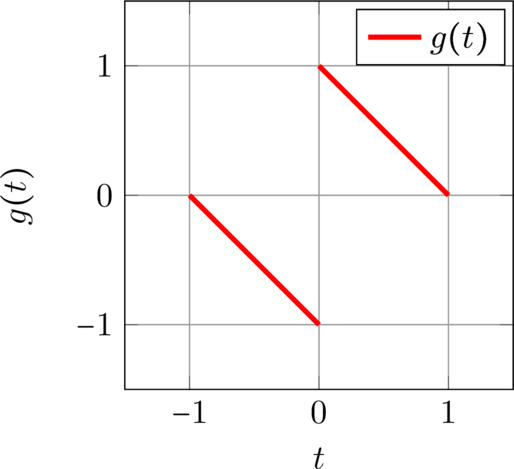
- Without performing any integration, what is the real part of $F(s)$?
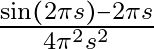
- Given the imaginary part of $F(s)$ as
 , what is $G(s)$?
The Intricacies of Real Parts in Fourier Transformations
The first question asks for the real part of $F(s)$ without integration.
From the previous reasoning, only the even component of a real function contributes to the real part of its Fourier transform. Here, $f(t)$ can be viewed as a combination of the scaled even function 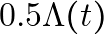 and the corresponding odd component
  .
.
Therefore,
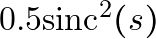
is the real part of $F(s)$.
Solving for $G(s)$
The second question asks for $G(s)$ using the known imaginary part of $F(s)$.
Since $g(t)$ corresponds to twice the relevant component of $f(t)$, we have $G(s)=2F(s)$ for that component. Therefore, using the given imaginary part,
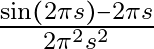
is the corresponding expression for $G(s)$.