
Table of Contents
谜题提出
问题 3
设 $f(t)$ 是一个实信号,其傅里叶变换为 $F(s)$。我们得到三条线索:
- $f(t)$ 是实函数。
- 当 $t leq 0$ 时,$f(t) = 0$。
- $mathcal{F}^{-1}{operatorname{Re}{F(s)}} = |t|e^{-|t|}$。
目标: 求 $f(t)$。
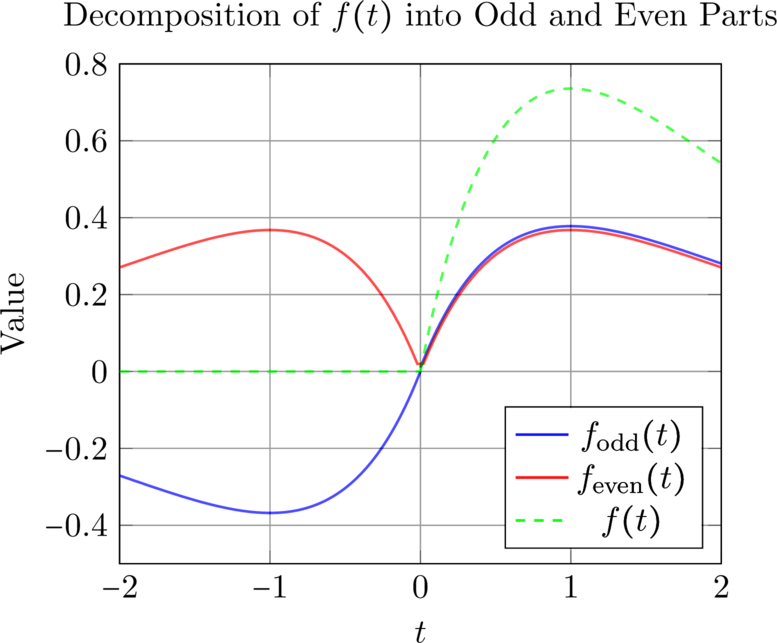
数学序章:奇函数与偶函数
每一个实函数 $f(t)$ 都可以分解为它的偶部与奇部:
![[ f(t) = f_{text{even}}(t) + f_{text{odd}}(t) ]](../images/quicklatex.com-56aa14559b275643632fba881313266e_l3.png)
其中
![[ f_{text{even}}(t) = frac{f(t) + f(-t)}{2} ]](../images/quicklatex.com-2f70346e68e13fb469c0e344a93b63c9_l3.png)
以及
![[ f_{text{odd}}(t) = frac{f(t) - f(-t)}{2} ]](../images/quicklatex.com-57534cff7159414fefe67c519516eeff_l3.png)
这个分解正是解码 $f(t)$ 的关键。
勾勒未知量
初始路径
由于 $f(t)$ 是实函数,它的偶分量贡献傅里叶变换的实部,而它的奇分量贡献傅里叶变换的虚部。因此,如果我们知道 $operatorname{Re}{F(s)}$ 的傅里叶反变换,就知道了 $f(t)$ 的偶部。
示意蓝图
我们的推理可以概括如下:
![[ begin{array}{cccccccccccc} & & f(t)& \ & & updownarrow{text{Decompose}}& \ & f_{text{odd}}(t) & + & f_{text{even}}(t) \ & downarrow mathcal{F} & & downarrow mathcal{F} \ & F_{text{odd}}(s) , (text{Imaginary, Odd}) & + & F_{text{even}}(s) , (text{Real, Even}) \ & downarrow text{Re{}} & & downarrow text{Re{}} \ & 0 & + & text{Re}{ F_{text{even}}(s) } \ & downarrow mathcal{F}^{-1} & & downarrow mathcal{F}^{-1} \ & 0 & + & mathcal{F}^{-1}{text{Re}{ F_{text{even}}(s) }} \ & & downarrow & \ & & mathcal{F}^{-1}{text{Re}{ F(s) }} = |t| e^{-|t|} & end{array} ]](../images/quicklatex.com-16c394d1bd9a4fb0a268377cb274e6f4_l3.png)
关键洞见
由于
![[ begin{array}{ccc} f_{text{odd}}(t) + f_{text{even}}(t) & = & 0 , (text{for } t < 0) end{array} ]](../images/quicklatex.com-6e74187270ce579d048387e868cc0988_l3.png)
并且偶部为 $f_{text{even}}(t)=|t|e^{-|t|}$,所以当 $t < 0$ 时,
$f_{text{odd}}(t) = -f_{text{even}}(t) = -|t|e^{-|t|}$。
最终揭示
因为 $f_{text{odd}}$ 是奇函数,
![[ begin{array}{ccc} f_{text{odd}}(t) & = & begin{cases} -|t| e^{-|t|} & text{for } t < 0 \ t e^{-t} & text{for } t > 0 end{cases} end{array} ]](../images/quicklatex.com-6996bbbf788fe4c2c8ba6f100cc8e8cf_l3.png)
因此原函数为
![[ begin{array}{ccc} f(t) & = & begin{cases} 0 & text{for } t leq 0 \ 2 t e^{-t} & text{for } t > 0 end{cases} end{array} ]](../images/quicklatex.com-6626e06a91e5544724ca195b59140c26_l3.png)
尾声:信号已被解码
信号 $f(t)$ 不再神秘。这个从傅里叶变换开始的谜题,最终变成了奇偶分解的直接应用:实部的反变换给出偶分量,而单边条件确定奇分量。因此,
故事继续:解开傅里叶变换的更多谜题
问题 4
考虑两个函数 $f(t)$ 和 $g(t)$,如下图所示。它们的傅里叶变换分别记为 $F(s)$ 和 $G(s)$。
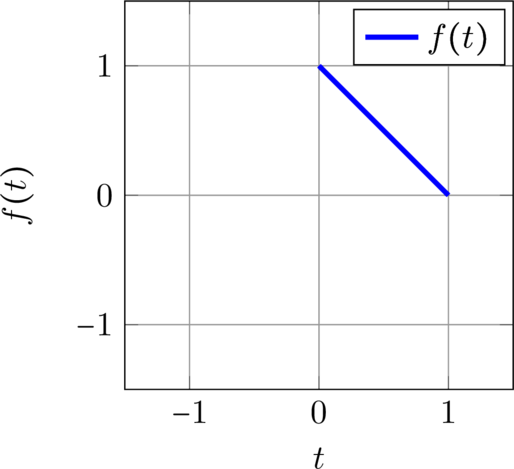
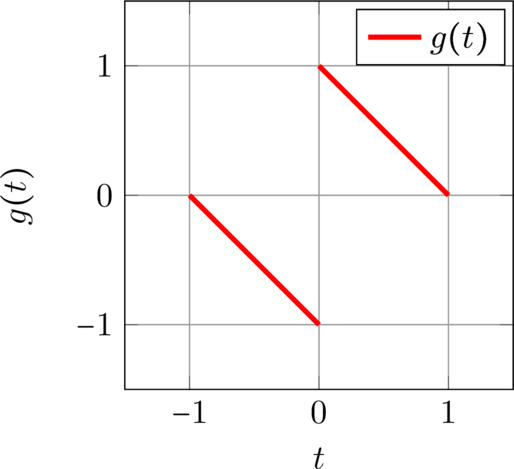
- 不进行任何积分,$F(s)$ 的实部是什么?
- 已知 $F(s)$ 的虚部为
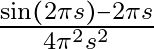 ,求 $G(s)$。
傅里叶变换中实部的细节
第一个问题要求不通过积分求出 $F(s)$ 的实部。
根据前面的推理,对于实函数,只有偶分量会贡献其傅里叶变换的实部。这里,$f(t)$ 可以看作由缩放后的偶函数 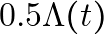 和对应的奇分量
  组合而成。
组合而成。
因此,
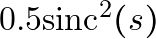
就是 $F(s)$ 的实部。
求解 $G(s)$
第二个问题要求利用已知的 $F(s)$ 虚部求 $G(s)$。
由于 $g(t)$ 对应于 $f(t)$ 中相关分量的两倍,因此对于该分量有 $G(s)=2F(s)$。所以,利用给定的虚部,
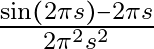
就是 $G(s)$ 对应的表达式。