
Table of Contents
Fermat’s Principle: A Prelude
The story begins with Fermat’s principle, which says that the path taken by light between two points is the path for which the travel time is stationary. In the simplest cases this is the path of least time, but the more durable statement is that a small variation of the path does not change the travel time to first order.
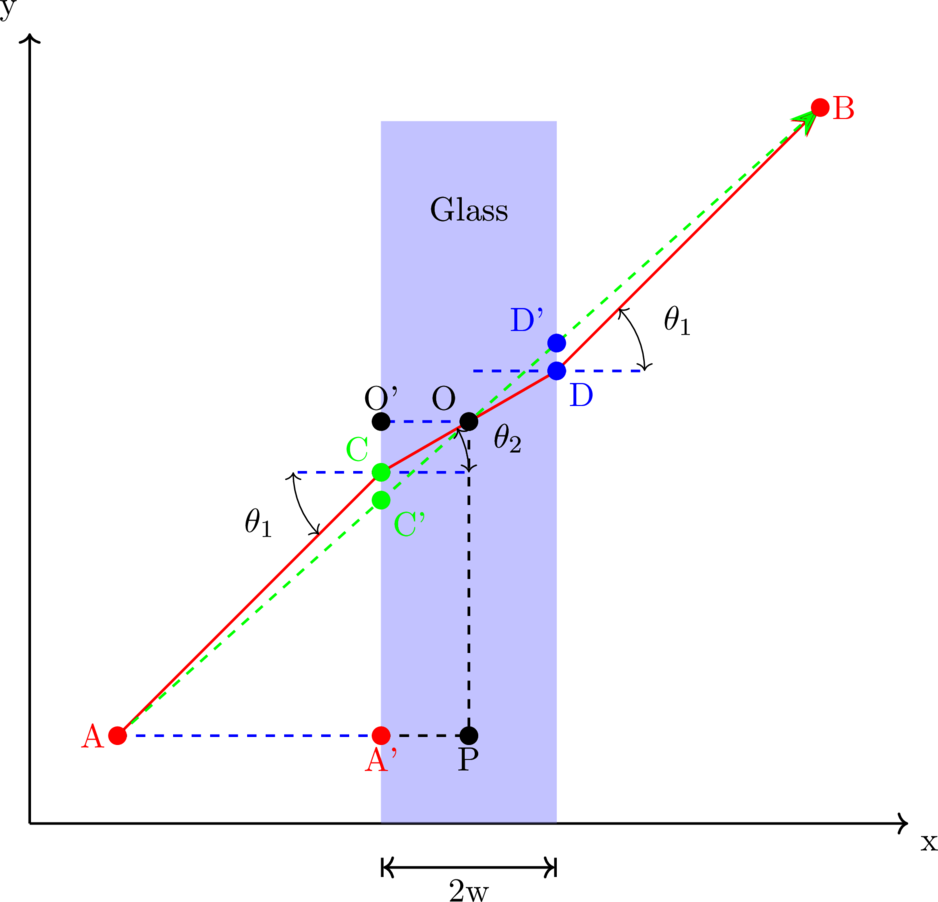
At its core, the principle is an optimization statement about light propagation. Snell’s law, which describes refraction at an interface, can be derived from it directly.
The Stage: The Geometry of the Light Path
Imagine a beam of light traveling through air, entering a glass slab, and continuing through the glass. Because light travels at different speeds in the two media, the shortest-time path is not generally the same as the shortest-distance path.
Let us describe the geometry as follows:
 is the distance light travels in air before entering the glass, and its length is
  .
. is the offset at the initial entry into the glass slab, and its length is $b$.
 is the variable distance $x$ that light further penetrates into the glass.
 is the width of the glass slab, and its length is
  .
.
The speed of light in air is  , and the speed of light in glass is
  .
.
The Equation of Time
For light to travel from  to
to  and then to some point
  along
along  , the total time $T$ is given by:
![\[T = \frac{\sqrt{a^2 + (b+x)^2}}{c_a} + \frac{\sqrt{w^2 + \left(\frac{wb}{a} – x\right)^2}}{c_g}\]](images/quicklatex.com-e4191fcba685a9f044ec4d9be3751c5f_l3.png)
The first term is the time spent in air, and the second term is the time spent in glass.
The Calculus of Light
The crux of Fermat’s principle is to find the value of $x$ that makes $T$ stationary. Mathematically, this means differentiating $T$ with respect to $x$ and setting the result to zero:
![\[\frac{dT}{dx} = \frac{x – \frac{bw}{a}}{c_g \sqrt{w^2 + \left(x – \frac{bw}{a}\right)^2}} + \frac{b+x}{c_a \sqrt{a^2 + (b+x)^2}} = 0\]](images/quicklatex.com-cf87ec9274e8cfe351c439296efca10f_l3.png)
Rearranging terms gives:
![\[c_a (x – \frac{bw}{a}) \sqrt{a^2 + (b+x)^2} = – c_g (b+x) \sqrt{w^2 + \left(x – \frac{bw}{a}\right)^2}\]](images/quicklatex.com-c186f2d1c71cf23efd9de577e975913f_l3.png)
This equation is already the geometric content of refraction: the ratios of the transverse offsets to the path lengths are the sines of the relevant angles.
The Grand Finale: Snell’s Law
Now introduce the speed of light in vacuum,  . The refractive indices of air and glass are related to the speeds by
![\[c_a = \frac{c}{n_a}, \qquad c_g = \frac{c}{n_g}.\]](images/quicklatex.com-9dd2091870ed1e8e78fc428c633aeb3d_l3.png)
Substituting these relations into the stationary-time condition gives the familiar form of Snell’s law:
![\[n_a \sin \theta_a = n_g \sin \theta_g.\]](images/quicklatex.com-32416ea023aea0689b9e8232fb407e19_l3.png)
Here  and
and  are the indices of refraction for air and glass, while and are the angles the ray makes with the normal in the two media.
Thus, from the simple premise that light chooses a path of stationary travel time, a law emerges that explains a wide range of optical phenomena, from the colors of a rainbow to the guiding of light through optical fibers. In the grand theatre of physics, Snell’s law and Fermat’s principle are not merely equations, but two ways of describing the same ballet of light.