A cat introduces himself with great confidence. Then, almost immediately, he admits that nobody has given him a name.
That is the opening of Natsume Sōseki’s I Am a Cat. You do not need to tackle the whole novel to enjoy those first two sentences:
吾輩は猫である。名前はまだ無い。
Try reading them before looking at the English. The small characters above the kanji in the screenshot are furigana: they give you the reading without replacing the Japanese text.
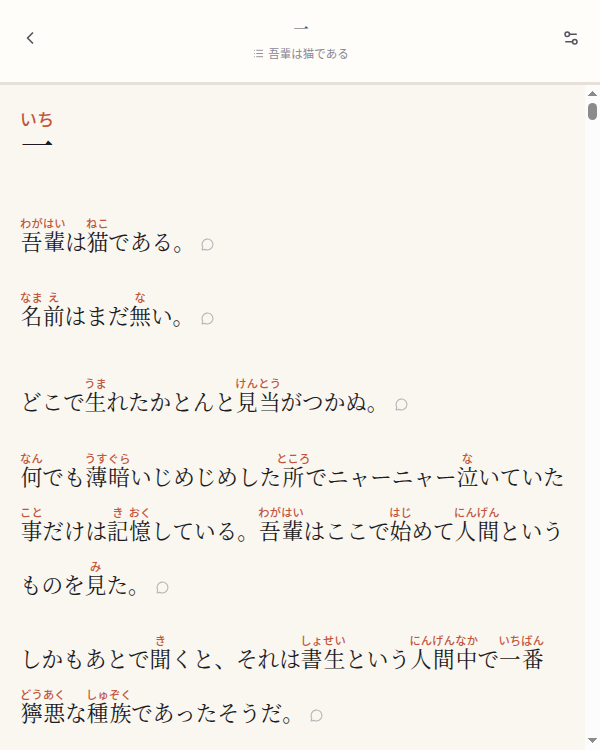
Actual Bunko browser reader, with the translation hidden.
Table of Contents
What the two sentences say
吾輩(わがはい) means “I,” but it is not a neutral everyday choice. Shogakukan’s dictionary describes its self-important tone. That makes it an enjoyable introduction to a cat who has opinions about humans. Dictionary entry.
猫(ねこ) means “cat.” である supplies the assertion: “I am a cat.” The sentence would be less distinctive if the narrator simply introduced himself with an ordinary 私.
In the next sentence, 名前(なまえ) is “name,” まだ is “yet,” and 無い(ない) means there is none. A plain rendering is: “I don’t have a name yet.” Bunko’s reading layer puts it as “As for a name, I have none as yet.”
The contrast is the pleasure here: such an important-sounding “I,” without so much as a name. The English gets you into the scene; returning to 吾輩 lets you notice something the plain word “I” does not carry by itself.
Compare the sentence without leaving it
This is the reading problem I built Bunko around. When a book, a dictionary and a translation live in separate places, checking a small detail can become more work than reading the passage.
In Bunko, open 吾輩は猫である, choose Japanese and English, and use the interlinear arrangement. The English follows the corresponding Japanese passage. Choose Source only when you want to try the Japanese again. Furigana can stay visible.
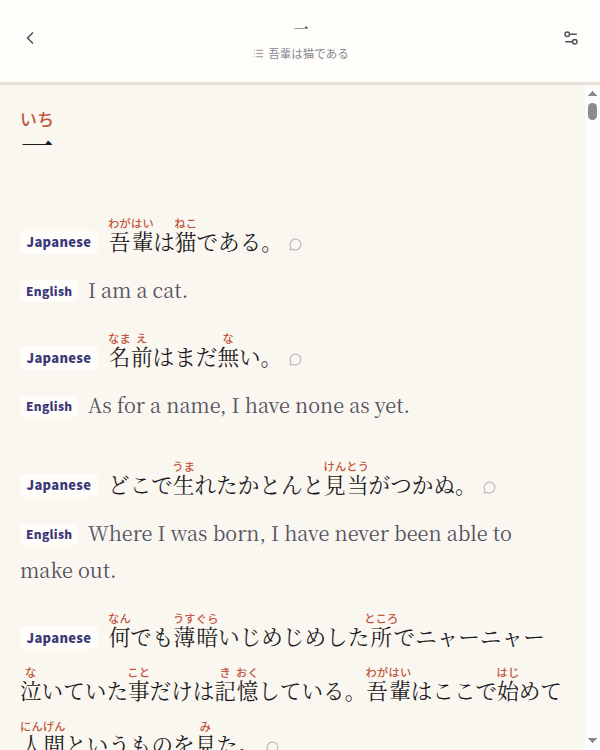
The same passage, with English added.
For this small exercise, read the two sentences, check the three readings わがはい・ねこ・なまえ, then hide the English and return to the original. You can do that with paper and a dictionary too. The app’s convenience is keeping the pieces together.
The rest of Sōseki’s novel is much harder than this opening; it is not a graded beginner course. You can read the original freely at Aozora Bunko. Bunko adds aligned, AI-assisted study translations, reading controls and downloadable books. For close literary study, compare the original and an edited translation rather than treating a generated rendering as definitive.
Bunko costs US$0.99 on the Apple App Store and Google Play. Ordinary library reading needs no account or subscription. If this is the kind of reading you want to do, start with this book and these two sentences.