
\section{Question 1}
Find the Fourier transform of the following signal. (Hint: make good use of the  function)
\begin{figure}[h]
\centering
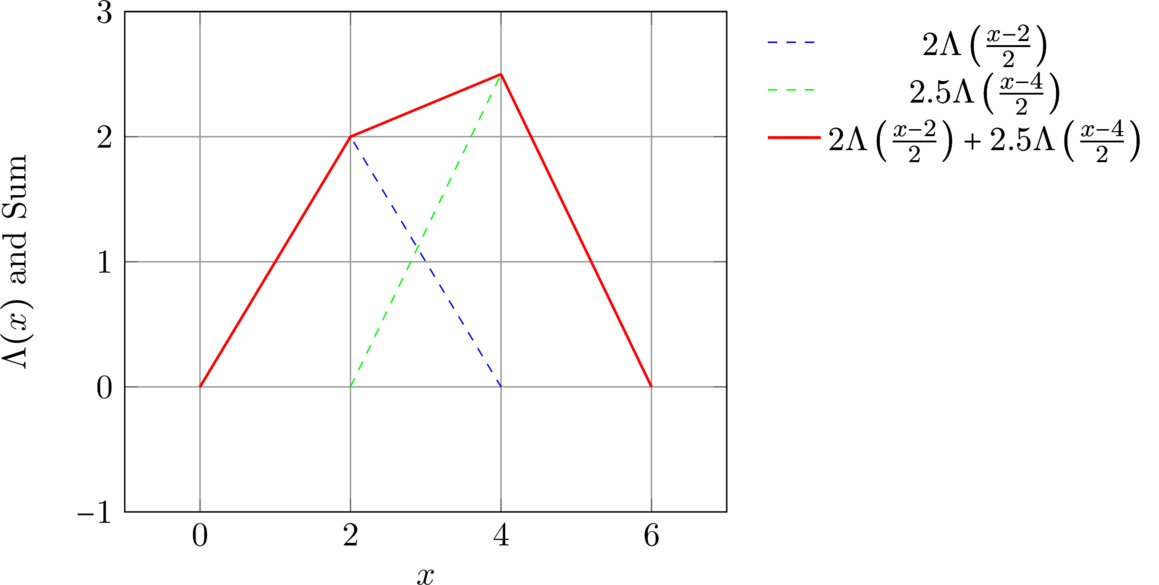
\caption{Time-domain representation of the signal in Question 1.}
\end{figure}
\textbf{Answer: }
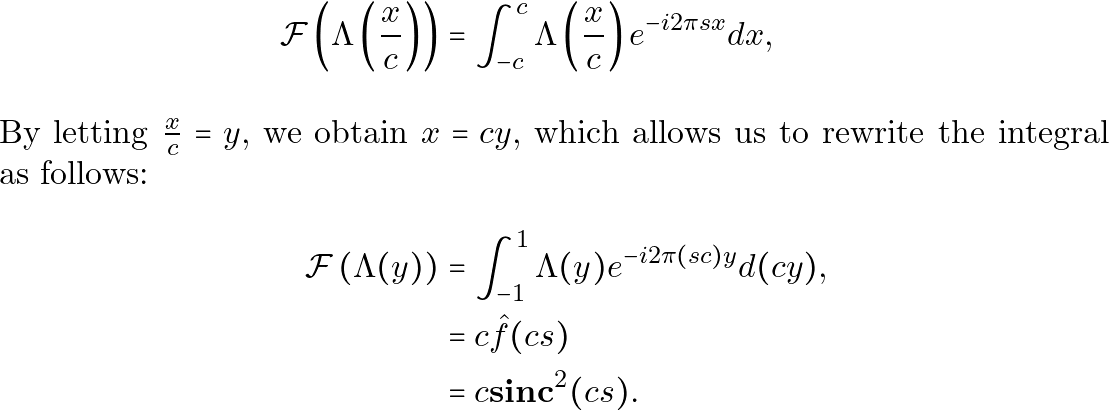
We commence our investigation by deriving the Fourier transform of the scaled function  .
.
(1) 
Leveraging the shift relation in Fourier transform,
![\[ g(t-b) \xleftrightarrow{} e^{-j 2 \pi b s} G(s), \]](https://blog.lazying.art/wp-content/ql-cache/quicklatex.com-7469763b97eee912bf6ab82ca47ceb62_l3.png "Rendered by QuickLaTeX.com")
we can extend the derivation to a generalized form for  :
:
![\[ \mathcal{F}\left(a\Lambda\left(\frac{x-b}{c}\right)\right) = a c \, e^{-j 2 \pi b s} \mathbf{sinc}^2(cs). \]](https://blog.lazying.art/wp-content/ql-cache/quicklatex.com-6e1e6949b6462642244daa56b6f6e559_l3.png "Rendered by QuickLaTeX.com")
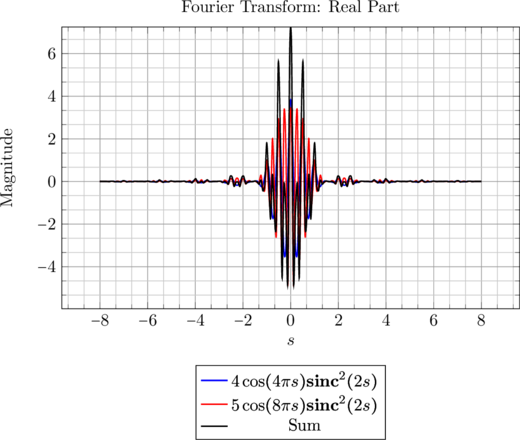
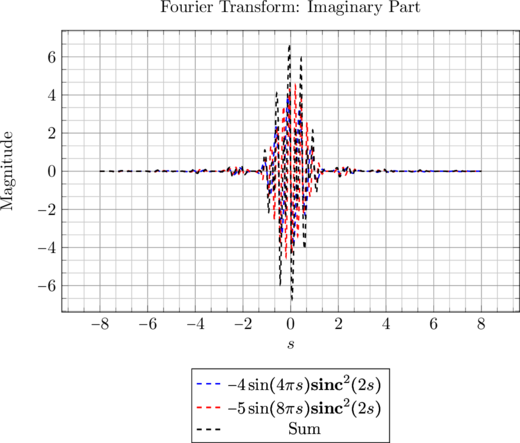
Thus, employing this generalized form, we deduce that (\Cref{fig:fourier_transform_2D})
![\[ \mathcal{F}\left(2\Lambda\left(\frac{x-2}{2}\right) + 2.5\Lambda\left(\frac{x-4}{2}\right)\right) = 4 e^{-j 4 \pi s} \mathbf{sinc}^2(2s) + 5 e^{-j 8 \pi s} \mathbf{sinc}^2(2s). \]](https://blog.lazying.art/wp-content/ql-cache/quicklatex.com-9720ee1e0d96e06cedf2164f5dc432fa_l3.png "Rendered by QuickLaTeX.com")
\begin{figure}[h]
\centering
\hbox{
\hspace{1cm}
}
\caption{Fourier Transform of  : Real and Imaginary Parts}
\label{fig:fourier_transform_2D}
\end{figure}
 简体中文
简体中文  English