
For the past several years, Leonard Susskind’s lectures and books have been one of the most important parts of my own physics self-study.
Like many people, I kept running into the same problem: the material was incredibly valuable, but it was scattered. Some notes existed only in old forum posts. Some PDF links had disappeared. Some supplemental courses were available as videos, but not as organized notes. Even when the material was still online, it was often difficult to browse as a coherent archive.
So I started keeping a repository for it, and I have now pushed it into a much more complete phase:
There is also a web reader and preview page on LazyLearn:
This is not an official Stanford archive. It is a maintained study archive that brings together Leonard Susskind lecture notes, transcript collections, subtitle files, generated companion notes, pocket builds, and published PDFs in one place.
Table of Contents
Start here: Classical Mechanics
If you arrived looking for Classical Mechanics: The Theoretical Minimum, these are the shortest paths:
- Open the Classical Mechanics web reader
- Open the course PDF on GitHub
- Browse the current full-size and pocket-size release bundles
Before starting, it helps to be comfortable with algebra and trigonometry, derivatives and integrals, vectors, and basic Newtonian mechanics: forces, energy, and momentum. Learn multivariable or vector calculus and ordinary differential equations when the course begins to need them; linear algebra becomes important before or alongside quantum mechanics.
The lectures are excellent for intuition, but intuition can arrive before fluency. After each topic, try to reproduce the central derivation without notes and solve a few problems from a conventional mechanics text. If a step is still unclear, use the transcript or subtitles to find the exact passage, then restate it mathematically in your own notation.
General Relativity: The Theoretical Minimum PDF and reader
If you are returning for the 2012 General Relativity course, the matching web reader and community-maintained lecture companion are here:
April 2026 update
The repository now has a visible book-preview layer. The cover images in the GitHub README are generated from the first pages of the actual course PDFs, so the preview cards match the books that readers download.
The archive now includes full-course PDFs, lecture-by-lecture PDFs, compact pocket editions, subtitle files, timestamped Markdown transcripts, and transcript-derived LaTeX source for a growing set of courses.
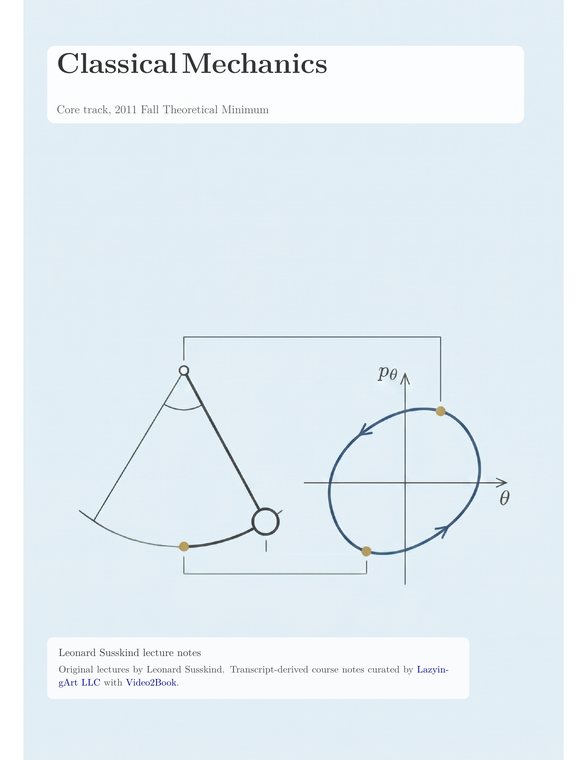
Classical Mechanics, from the Theoretical Minimum sequence.
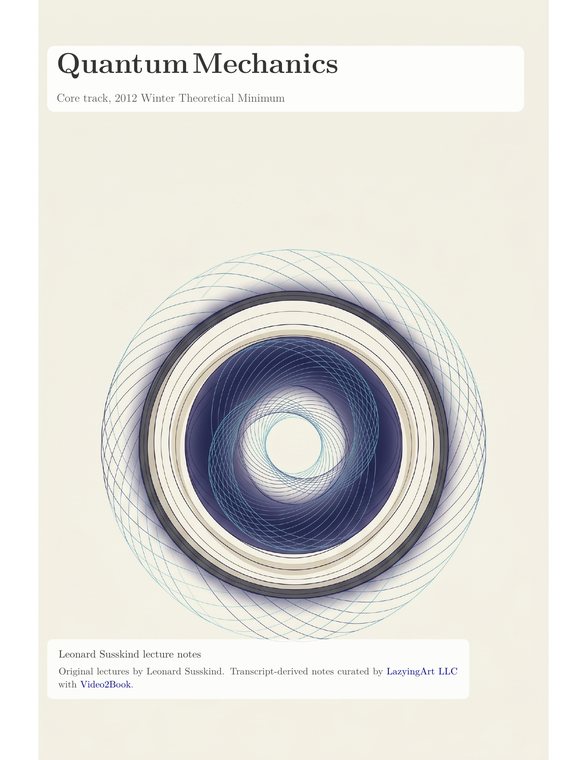
Quantum Mechanics, with a first-page preview from the generated course book.
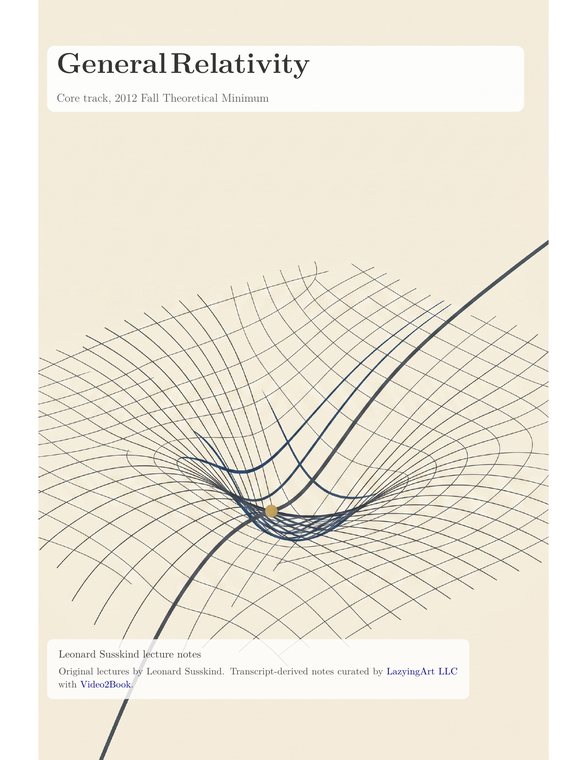
General Relativity, formatted as a browsable course book.
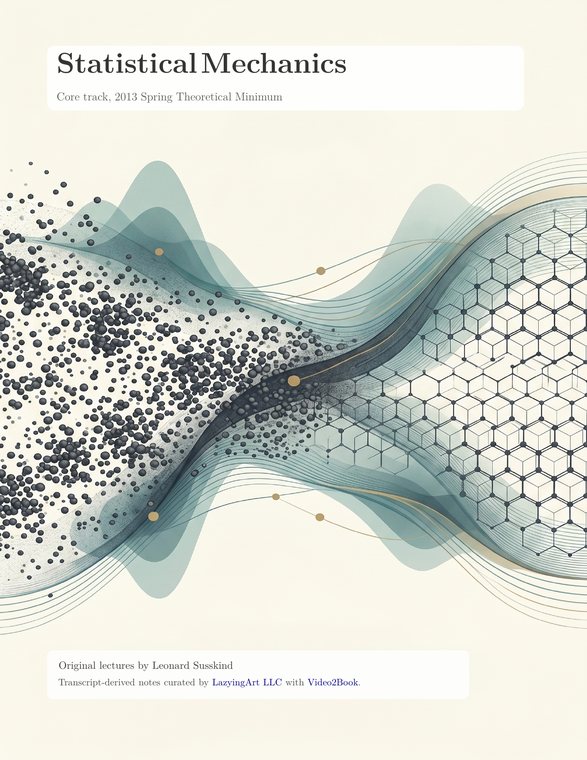
Statistical Mechanics, one of the newly organized course-book outputs.
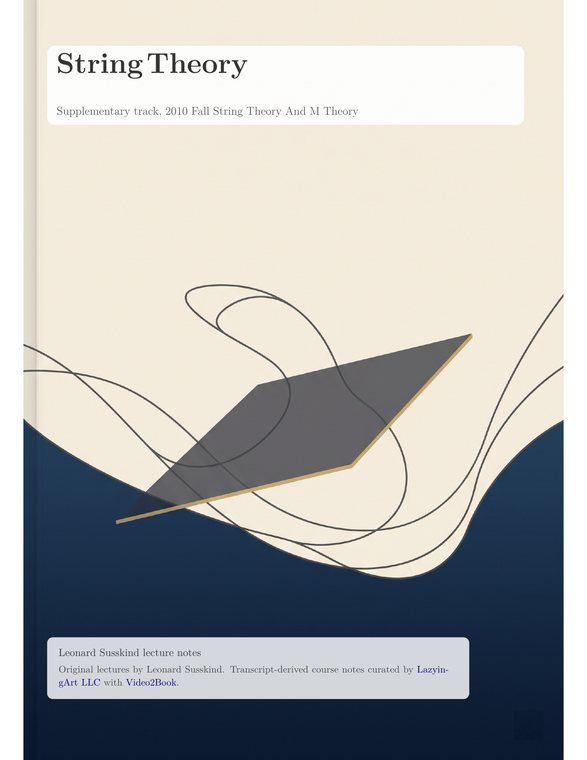
String Theory and M-Theory, part of the supplemental course archive.
What is in the repository
The repository currently includes:
- published PDF notes for several core and supplemental courses
- pocket-size 1.0x and 1.2x PDF builds for finished books
- subtitle files for the lecture archive
- timestamped Markdown transcripts
- transcript-derived LaTeX notes and compiled course PDFs
- related companion material connected to The Theoretical Minimum
Some of the published course-book outputs now available there include:
- Classical Mechanics
- Quantum Mechanics
- Special Relativity
- General Relativity
- Statistical Mechanics
- Cosmology
- Advanced Quantum Mechanics
- Quantum Entanglement, Part 1 and Part 3
- Topics in String Theory
- String Theory and M-Theory
- Demystifying the Higgs Boson
- Particle Physics 1: Basic Concepts
- Particle Physics 2: Standard Model
- Particle Physics 3: Supersymmetry and Grand Unification
Repository:
Web reader:
Why I kept working on it
This is not a random archive project for me.
Susskind’s lectures helped shape how I learned physics. I have been following his material for about six years, and it influenced not only my reading but also how I think about learning difficult subjects: start from physical meaning, build intuition carefully, and then return to the formalism with better questions.
At one point, that influence became concrete enough that I even published a paper partly inspired by ideas and habits of thought that grew out of reading his books.
That is why I kept maintaining the repository even when it was under-maintained for long stretches. The value of the material never really went away.
How the archive is maintained
I now use my own Video2Book tooling and a repeatable editorial workflow to keep the archive more systematic.
That means:
- downloading and organizing lecture archives more cleanly
- transcribing lectures into subtitles and searchable Markdown
- generating structured companion notes course by course
- compiling those notes into readable PDFs
- publishing cover previews so each course feels like an actual book, not a loose folder
The goal is not to replace careful reading or real physics study. The goal is to make the archive more durable, searchable, and easier to build on.
If you are curious about the tooling side, that companion project is here:
If you own or can reuse one English lecture, inspect the complete project-owned sample first. The fixed USD 250 pack covers one primary speaker, up to 20 minutes, and one Traditional Chinese or Japanese track; the free fit check comes before any upload or payment.
Who this may help
This archive may be useful if you are:
- learning from The Theoretical Minimum
- looking for Leonard Susskind supplemental-course notes
- trying to study from video lectures more seriously
- building your own long-form lecture archive
- interested in source-aware technical education archives
- looking for a compact reader-friendly PDF set rather than scattered lecture links
A small invitation
If you know of missing PDFs, cleaner scans, better sources, or corrections, I would be glad to improve the archive.
And if you care about physics education, long-form lecture preservation, or turning great lecture series into durable study material, I think there is still a lot more to build here.
The main links again:
- https://github.com/lachlanchen/leonardsusskind
- https://learn.lazying.art/leonardsusskind-reader.html
I wanted to share it simply because it may save other people the same searching, link-chasing, and fragmented note-gathering that I had to do myself.