Reading a paper often means keeping several things open: the PDF, a note, a translation and a conversation about a sentence you did not understand. Once those windows drift apart, it becomes surprisingly easy to lose which claim came from the paper and which came from the explanation.
I’m building OnlyIdeas around a smaller unit: the passage you are reading and the question you have about it. It is a research reading room, with equations and figures kept in the text and room for discussion nearby.
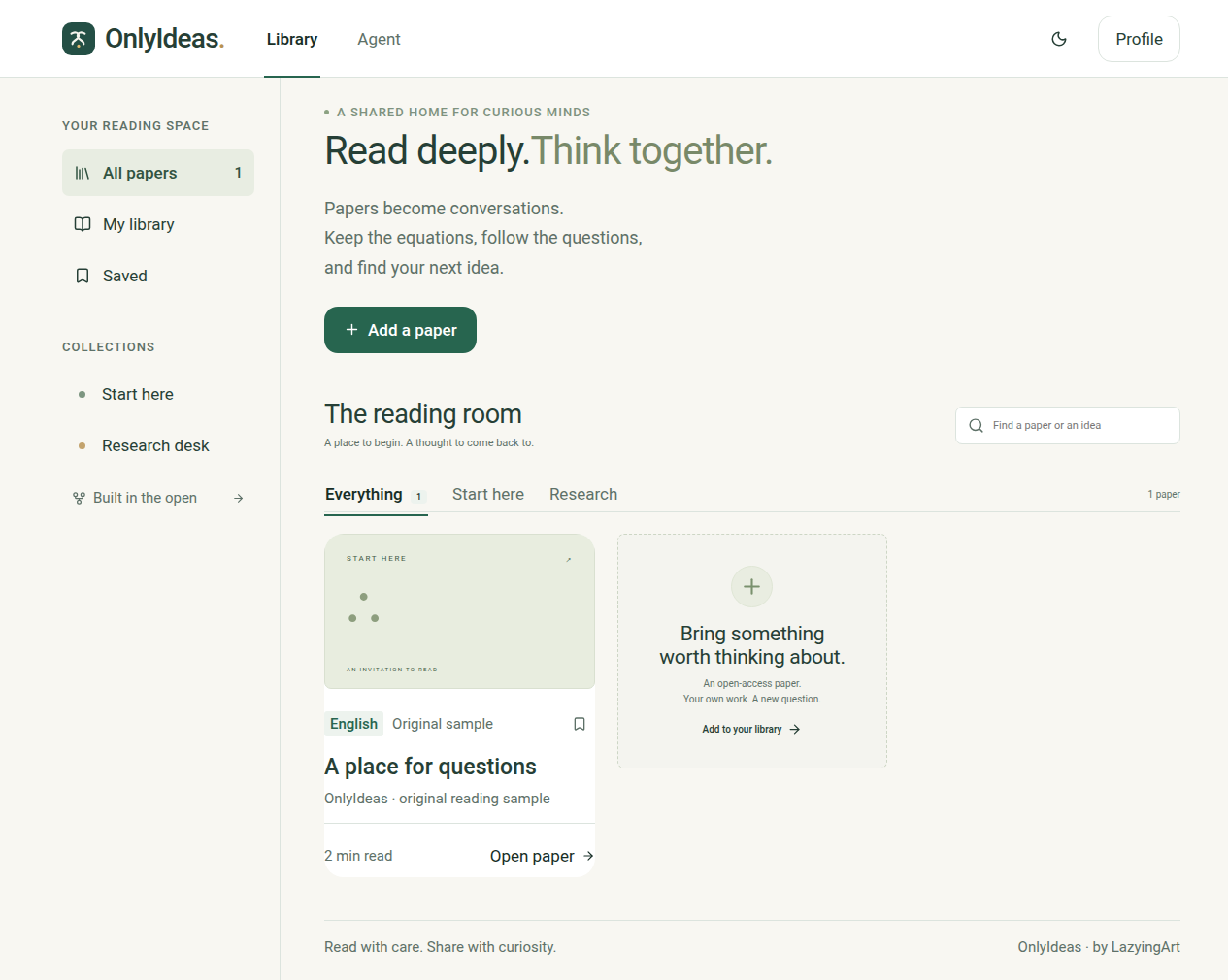
The public sample is a place to try the reader before importing a paper.
Table of Contents
Keep the original within reach
Start with one paper and one section. Read the paragraph around an equation before asking for a summary. Try writing a specific question: “What does this symbol refer to?” or “Which assumption lets this step follow?”
Those questions are easier to check than “explain the whole paper.” When an explanation comes back, compare it with the original sentence, the notation and the figure caption. A fluent answer can still misunderstand a definition.
OnlyIdeas keeps generated reading guides and translations separate from the source text. You can use them to get unstuck without quietly replacing the paper with a smoother version of what a model thinks it says.
A reading copy is not the original PDF
The import workflow can turn a PDF into Mathpix Markdown, keeping TeX equations and durable figure files rather than flattening everything into plain text. That makes a narrow reading screen more practical, especially when a two-column PDF would otherwise need constant zooming.
Conversion still needs checking. A missing minus sign, a figure detached from its caption or an incorrectly recognized subscript can change the meaning. For the first import, compare one equation, one figure and one ordinary paragraph with the PDF. Keep the source link so you can return to it.
Bring a paper you are allowed to process. A PDF being freely readable on a website does not automatically permit republishing it. Personal imports and notes begin privately; publishing a paper bundle is a separate, rights-cleared action. PDF conversion and AI requests use external services, so private-library visibility does not mean that all processing happens on your device.
Ask something you can come back to
The question worth saving may be very small: why a boundary condition was chosen, where a measurement came from, or whether a result applies outside the reported range. Keeping it attached to a passage gives you a useful starting point when you return a week later.
OnlyIdeas also has a paper-search agent, but finding another PDF is not always the next step. Sometimes the better move is to finish the paragraph already open.
The web reading room has an original sample you can open before signing in. Personal imports and saved work need an account. The iOS and Android versions are currently in internal testing, not a public store release.
The public project documents the reader and its boundaries. Try the sample first, choose one passage, and see whether keeping the question beside the text makes it easier to stay with the paper.