
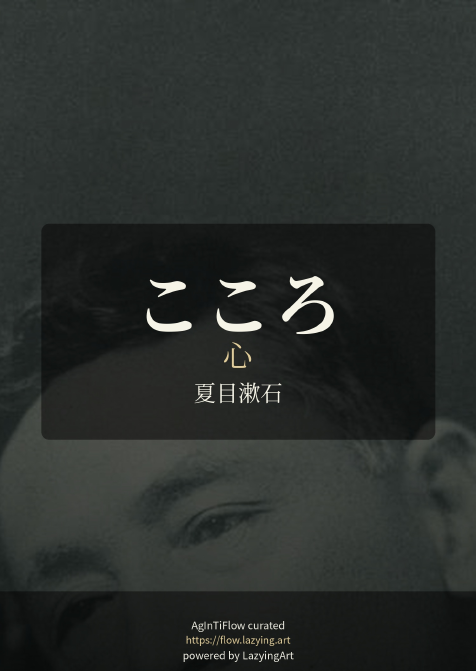
Natsume Soseki's Kokoro is a novel best read slowly. It does not pull readers forward through plot, but unfolds little by little through tone, pauses, honorific language, silence, and psychological distance. For learners of Japanese, this book is especially distinctive: you are not just reading a story, but seeing how modern Japanese expresses hesitation, restraint, shame, trust, and betrayal.
The PocketPolyglot edition of Kokoro is designed to solve a common problem: the Chinese translation reads smoothly, while the original Japanese can easily feel fragmented by kana, kanji readings, and long sentence structures. We turned it into a pocket-sized line-by-line parallel PDF: one line of Japanese or Chinese main text, followed immediately by notes in the corresponding language; full kana are added above Japanese kanji, and pinyin above Chinese; the color edition also uses grammatical color coding to help readers identify structures such as subject, predicate, object, and adverbial elements.
This is not an ordinary “left-right parallel text.” PocketPolyglot is closer to a close-reading edition that learners can flip through at any time. You can start with the Chinese main text and read the story continuously, or switch to the Japanese main text and use the Chinese as annotation. The black-and-white edition suits e-readers, while the color edition works best on tablets and computers.
The charm of Kokoro lies precisely in what is said and yet not fully said. A line-by-line parallel format lets readers see where the same psychological movement sits in two languages: how Japanese avoids stating things directly, how Chinese fills in the meaning, and how sentence endings leave an aftertaste. For Japanese learners, this comes closer to real reading than memorizing vocabulary.
Initiated by LazyingArt, PocketPolyglot combines AgInTiFlow's long-task orchestration capabilities to connect text cleanup, annotation, sentence-by-sentence alignment, JSON structuring, TeX typesetting, and PDF compilation into a reusable workflow. The goal is not just to make one book, but to let every bilingual text suited for close reading become a beautiful, portable, reviewable learning book.
Table of Contents
PDF Editions
The links below use GitHub Releases direct-download format. Before publishing, please first confirm that the PDF of this book may be publicly redistributed, and upload the corresponding release assets.
| Edition | Pages | Link |
|---|---|---|
| Japanese Main Text · Color | 684 | Open PDF |
| Japanese Main Text · Black and White | 684 | Open PDF |
| Chinese Main Text · Color | 674 | Open PDF |
| Chinese Main Text · Black and White | 674 | Open PDF |
A good way to read it: first read the Chinese-main-text edition, then the color Japanese-main-text edition, and finally review on an e-reader with the black-and-white edition.