
Historical correction and audit (September 1, 2026): This reviews a EUR/USD short-term forecast that expired in 2018. It is not a current market view, trading signal, backtest result, or invitation to open an account. The surviving evidence cannot honestly establish that the forecast “won” or “lost,” so the result is classified as unverifiable.
Table of Contents
Audit conclusion
The old post listed several levels and a bearish view, but it did not preserve a fully reproducible issue time, time zone, source dataset, quote convention, expiry, or execution rule. The attached chart supplies a few clues, but not enough to close those gaps. Declaring a “hit” from a later daily price or a conveniently selected chart would confuse hindsight selection with a pre-specified test.
This page therefore retains the old forecast only as a methods case. It does not continue its directional view or calculate a win rate or return.
Expired 2018 case record
The table records exactly what the old post and chart left behind. Every direction and level below is expired and appears only for audit.
| Field | Old record | Audit note |
|---|---|---|
| Page publication time | 2018-08-02 00:11:40 | The page does not identify the time zone, and this cannot prove when the forecast was issued. |
| Chart label | EUR/USD, 30 minutes, 21:23:53 (CET) | The chart has no complete date. It is also unclear whether “CET” means fixed UTC+1 or the provider's shorthand for European local time. |
| Chart attribution | “Research © 2018 TRADING CENTRAL” | This is a visible label, not a verified source link, licence, original report, or data-vendor record. |
| Reference close | 1.1660 | The record does not say whether this is bid, ask, mid, or which 30-minute bar closed there. |
| Pivot | 1.1680 | The old text was bearish below it and bullish above it, but did not define how “below/above” triggers. |
| Old downside targets | 1.1645 and 1.1635 | The differences from 1.1660 are 0.0015 and 0.0025. The title did not define what it meant by a “point.” |
| Old alternative targets | 1.1700 and 1.1720 | The record does not say when the alternative starts or how it is made mutually exclusive from the first case. |
| Additional level | 1.1620 | The old list supplied no reproducible strength score or use rule. |
| Technical rationale | RSI bearish, with room to decline | The chart shows “RSI14 - 9MA,” but the input, smoothing, data source, and test rule were not preserved. |
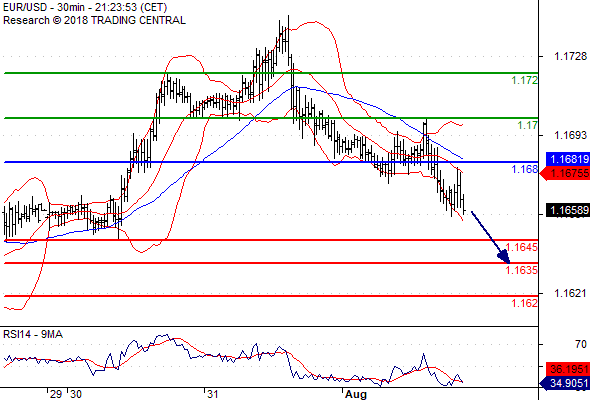
The image was part of the old post and is retained only to show what the record contained. Its arrow and levels are not current recommendations.
Why the result cannot be reproduced honestly
- The time boundary is incomplete. The page time has no time zone; the chart time has no date; and no start or expiry was defined. For an intraday forecast, shifting by one 30-minute bar can change the observed path.
- The price source is incomplete. There is no universal price stream representing every executable FX quote. The post did not preserve a vendor, venue or dealer, bid/ask/mid convention, bar time zone, or raw data file.
- The decision rule is incomplete. “Below 1.1680” could mean already below at publication, an intrabar touch, a closing confirmation, or an actual fill. The two targets have no time limit, invalidation, or path-order rule. Different definitions can produce different outcomes.
- The indicator definition is incomplete. An RSI period label cannot reconstruct the value by itself. The input price, smoothing, initialization, missing-value handling, and rounding are also needed.
- The executable result is incomplete. A chart touching a level does not prove an order could fill there. Spread, slippage, fees, overnight financing, and rejected orders were not recorded; nor were position size or a risk limit.
These are not minor details that an auditor may safely guess. A sound audit has only three broad conclusions: an outcome supported by evidence, clearly not triggered, or unverifiable for lack of evidence. This case belongs in the third category.
What public data can and cannot establish
The European Central Bank says its euro reference rates are determined at about 14:10 CET on working days and published at about 16:00 CET for information purposes only, not market transactions. Its framework distinguishes transaction data from bid and offer quotes and applies data-consistency checks. That illustrates why time, source, and quote construction must be specified.
An ECB daily reference rate cannot replace the raw price stream used for this 30-minute forecast, however, or establish which target was first reachable under executable conditions. Judging an intraday call with one daily reference observation mismatches both frequency and purpose.
The U.S. CFTC's retail OTC forex advisory also explains that, in its regulatory context, customers may face a dealer rather than an open exchange, the dealer controls prices displayed on its platform, and margin and leverage amplify both gains and losses. Those are data-source and risk warnings, not allegations about any named platform, and they do not replace the rules in a reader's jurisdiction.
Risk-first forecast-audit checklist
1. Preserve the evidence first
- Save the original text, chart, link, or file hash; do not overwrite it with a version created after the outcome.
- Record the author or institution, issue time, ISO 8601 time zone, first-observed time, and explicit expiry.
- Name the product type, venue or dealer, data vendor, pair quotation direction, and bid/ask/mid field.
2. Freeze the rules in advance
- Define a pip or “point,” the baseline price, entry trigger, targets, invalidation, and maximum observation window.
- Record bar interval, bar time zone, indicator formula, parameters, inputs, and rounding.
- State how to handle one bar crossing several levels. Do not choose the rule after viewing the path.
3. Put execution and loss boundaries first
- Distinguish a chart price, executable bid/ask, and actual fill; include spread, slippage, fees, and financing.
- Before any real decision, assess maximum possible loss, leverage, margin-call, and counterparty risk separately. A directional view cannot replace those checks.
- Do not turn “the chart touched a target” into a profit. Without a pre-specified position and verifiable fill, there is no trading return to report.
4. Classify the result only at the end
- Using only the pre-specified data and rules, record hit, miss, not triggered, or unverifiable.
- Report every sample and rule change, not only favorable cases.
- Keep a historical audit separate from a new market view. This page supplies no new market view.
Use boundary
This is a note about source literacy and audit method, not investment, legal, or tax advice, and not a basis for taking any EUR/USD position. It contains no current price, entry, stop, position size, or leverage suggestion. When records are incomplete, the safe and truthful answer is “unknown,” not a precise-looking performance history.
Primary sources and uncertainty
- U.S. Commodity Futures Trading Commission: Eight Things You Should Know Before Trading Forex
- European Central Bank: Framework for the euro foreign exchange reference rates (June 23, 2026)
- European Central Bank: Euro foreign exchange reference rates
Sources were checked on September 1, 2026. The CFTC material concerns the U.S. retail OTC forex environment; rules differ across jurisdictions and products. The old chart's full date, the provider's time-zone convention, original report, price feed, permission chain, and forecast expiry remain unconfirmed from the surviving files. No result is inferred from them.