
Archival correction (1 September 2026): This was originally a short-term USD/JPY directional forecast. Its levels expired years ago and must not be used for trading today. The revision preserves the chart and numbers as a research sample, removes direct calls to action, makes no claim of profit, win rate, or “precise hit,” and recommends no dealer.
Table of Contents
What the 2018 Archive Actually Preserved
| Item | Archived record |
|---|---|
| Currency pair and interval | USD/JPY, 30-minute chart |
| Time shown in the chart | 2018-08-01 09:23:45 CET |
| Attribution shown | Trading Central research chart |
| Approximate displayed quote | About 112.10; the black chart label reads 112.097 |
| Dividing level | 111.55 |
| Old scenario above the level | 112.20, followed by 112.50 |
| Old alternative below the level | 111.15, followed by 110.90 |
| Technical rationale | RSI moving upward; the post preserved no calculation parameters, trigger rule, or expiry |
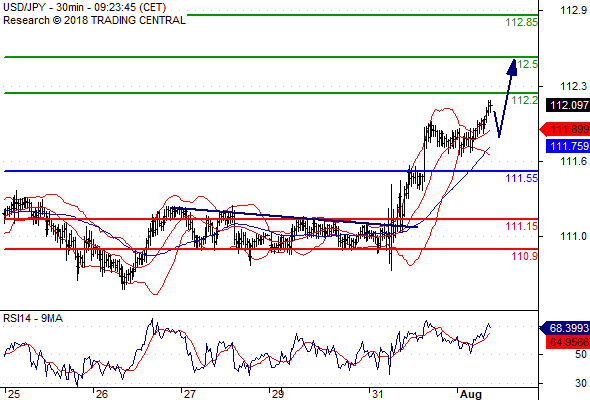
Historical image: its arrow and levels record a forecast made at the time; they are not a current signal.
The original title said “rise 20–50 points,” apparently comparing roughly 112.00 with 112.20/112.50. It did not define “point,” pip, or the platform’s minimum quote unit, nor did it say whether 112.00 was a bid, ask, midpoint, or bar close. An audit cannot add those definitions for the author or convert the title directly into achievable profit.
Why “Hit” or “Failed” Cannot Be Scored Honestly
A scoreable intraday forecast must specify before the outcome: publication time and timezone, reader-availability time, quote source, bid/ask side, trigger, order type, targets, stop or other invalidation, maximum horizon, and cost model. Most of those fields are absent here.
There is also no tick- or minute-level two-sided price record covering a defined validity window. One chart, a daily close, or a daily reference observation cannot prove which executable intraday level came first. If one bar contains both a target and an invalidation level, the order is uncertain without finer data.
It would therefore be hindsight to choose a favourable holding period, quote side, or dealer chart after observing later prices. Directional resemblance without preregistered rules is a story, not a reproducible result.
Official Daily Observations Provide Boundaries Only
The Federal Reserve/FRED DEXJPUS series comes from the Federal Reserve H.10 release, is expressed as Japanese yen per US dollar, and is described as noon New York buying rates for cable transfers payable in foreign currencies. It is a daily observation—not the source of this Trading Central chart and not a continuous executable bid/ask series.
| Date | FRED DEXJPUS: yen per US dollar |
|---|---|
| 2018-07-31 | 111.88 |
| 2018-08-01 | 111.72 |
| 2018-08-02 | 111.48 |
The 1 August observation is below the chart’s roughly 112.10 but above the 111.55 dividing level; the 2 August observation is below that level. These different daily observations show that a later official point was lower. They do not reveal whether an executable ask reached 112.20 first, whether an executable bid crossed 111.55 first, or when the forecast should have expired. They cannot establish a net result after spread, commission, financing, and slippage.
Audit Result: Indeterminate
This sample should be labelled indeterminate, not successful or failed. The surviving evidence reconstructs what was said, but not a completely specified transaction. That is not avoiding analysis; it is keeping the scoring rule unchanged when evidence is missing.
The useful response to historical material is not to select one apparently correct call. It is to turn every missing field into something the next forecast must state in advance.
Reusable Forex Forecast-Audit Protocol
1. Freeze the Forecast First
- Preserve the text, image, publication time, availability time, timezone, author/provider, and file hashes.
- Record the market or venue, data provider, quotation direction, bid/ask/midpoint convention, and chart interval.
- Define the point and pip units, entry trigger, order type, targets, invalidation, and maximum horizon.
- Disclose compensation, referrals, affiliations, and other conflicts; never alter the rules after the result appears.
2. Match the Data to the Question
- An intraday level audit needs sufficiently granular, timestamped bid and ask data covering the whole window; daily values are context only.
- Preserve raw data and its licence, timezone, daylight-saving treatment, missing values, bad ticks, revisions, and provider changes.
- Use only data available after public release, avoiding look-ahead bias and retrospective selection of the most favourable quote.
- If the data cannot order target and invalidation, label the case “sequence unknown” rather than guessing.
3. Define Scoring in Advance
- At minimum distinguish: not triggered, target first, invalidation first, expired unresolved, sequence unknown, and insufficient data.
- For multiple targets, define partial scoring and apply one rule set to the whole sample.
- Report “directionally similar,” “chart level observed,” and “executable and positive after costs” as different claims.
- Preserve a consecutive sample including failures, untriggered forecasts, and indeterminate cases; never show only winners.
4. Put Risk and Costs First
- Without an invalidation and position rule, maximum loss cannot be estimated reliably. Set per-position and portfolio risk limits before research.
- Stress-test spread, commission, markup/markdown, financing, slippage, latency, gaps, and rejected orders.
- The CFTC warns that retail OTC forex commonly puts the customer directly against the dealer, which controls the platform and displayed prices; leverage magnifies gains and losses.
- Before considering a real account, verify authorization, disciplinary history, funding, and withdrawal terms under local rules. CFTC/NFA searches cover only their US jurisdiction.
5. Evaluate a Sample, Not a Story
- Preregister a batch and fixed protocol, then use out-of-sample evaluation; log every rule or parameter change.
- Report sample size, scoreable coverage, gross and after-cost results, maximum drawdown, and the worst case.
- Hit rate alone does not establish profitability, and simulated performance does not guarantee future returns.
- Permit “indeterminate” when evidence is absent; that is more credible than precision manufactured by interpolation or a retrospective screenshot.
When Reading Market Content Today
Do not copy this post’s 2018 levels. For any new forecast, ask: When does it expire? How is maximum loss bounded? Which source and quote side will verify it? How will it be scored after all costs? A chart does not make material reliable when it promises fixed high returns, urges immediate funding, hides marketing conflicts, or funnels readers into private messages and referral links.
US NFA rules require applicable retail forex members to disclose commission, other fees, markups or markdowns, or midpoint-spread cost. The CFTC advises checking dealer and salesperson registration and disciplinary history before depositing money or providing sensitive information. These are risk-identification sources, not substitutes for the law where a reader lives or personalised financial advice.
Primary Sources Consulted
- Federal Reserve/FRED: DEXJPUS series, source, and methodology
- Federal Reserve/FRED: historical CSV, 31 July–2 August 2018
- CFTC: Eight Things You Should Know Before Trading Forex
- NFA: Forex Transactions Regulatory Guide
Verified on 1 September 2026. Historical series can be revised; retain the version used and its retrieval date when replicating the audit.